http://www.pcworld.com/article/173221/father_of_fiberoptics_snags_nobel_physics_prize.html
'Father of Fiber-Optics' Snags Nobel Physics Prize
Charles Kao, sometimes referred to as the "father of fiber-optic communications," was formally honored by the Nobel Foundation in Stockholm, for his work from 1966 of extending fiber-optic networks.
Charles Kao, whose work in the 1960s laid the foundation for today's long-distance fiber-optic networks, has won a share of this year's Nobel Prize in Physics.
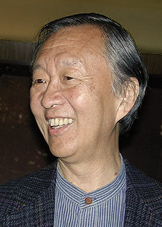 Kao photo from Nobel organization via Richard EpworthKao, sometimes referred to as the "father of fiber-optic communications," was formally
honored by the Nobel Foundation in Stockholm, Sweden "for groundbreaking
achievements concerning the transmission of light in fibers for optical communication"
Kao photo from Nobel organization via Richard EpworthKao, sometimes referred to as the "father of fiber-optic communications," was formally
honored by the Nobel Foundation in Stockholm, Sweden "for groundbreaking
achievements concerning the transmission of light in fibers for optical communication"
The Shanghai-born Kao shares the award with Willard Boyle and George Smith, who invented imaging technology using a digital sensor dubbed a CCD (Charge-Coupled Device) that makes use of the photoelectric effect theorized by Albert Einstein under which light is transformed into electric signals.
More technical details on the prize winners' efforts are outlined in this paper.
Kao's breakthrough discovery in 1966 was to determine how to transmit light over long distances using ultrapure optical glass fibers. This would extend the distance of such transmissions to 62 miles vs. the mere 65 feet allowed under previous technology held back by impurities. The first ultrapure fiber was created in 1970.
According to the Nobel organization, if all the glass fibers in the world were put end to end, they would circle the globe more than 25,000 times.
Kao accomplished his work while with Standard Telecommunication Laboratories, Harlow, UK, which eventually became part of Nortel. He is now Chairman of ITX Services.
More recent research into fiber-optics has resulted in such findings as those by researchers from Alcatel-Lucent who have multiplied the fastest undersea cable speeds by a factor of 10 and by researchers from the Technion-Israel Institute of Technology who have come up with a way to use the same sort of fiber-optic cables used for telecom to detect tunnel excavation at depths of more than 60 feet.
Ooooooooooooooooooooooooooooooooooooooooooooooooooooooooo
Tuesday, October 06, 2009
Charles Kao, Father Of Fiber-Optic Communications, Shares Physics Nobel Prize With CCD Inventors Willard Boyle And George Smith,
Charles Kao wins Nobel Prize snapvoip.blogspot.com
http://snapvoip.blogspot.com/2009/10/charles-kao-father-of-fiber-optic.html

Charles Kao, who is often referred as father of fiber-optic communications for his work in the 1960s fiber optics has won a share of this year’s Nobel Prize in Physics. Kao’s discovered in 1966 how to transmit light over long distances using ultrapure optical glass fibers, which enabled such transmissions to reach 62 miles vs. the mere 65 under the previous technologies hampered by impurities. The first ultrapure fiber was produced in 1970.
Kao, was formally honored by the Nobel Foundation in Stockholm, Sweden "for groundbreaking achievements concerning the transmission of light in fibers for optical communication. Kao shares the award with Willard Boyle and George Smith, who invented imaging technology using a digital sensor dubbed a CCD (Charge-Coupled Device)
Read more: http://snapvoip.blogspot.com/2009/10/charles-kao-father-of-fiber-optic.html#ixzz1MU1AeRCY
ooooooooooooooooooooooooooooooooooooooooooooooooooooooooo
http://www.npr.org/templates/story/story.php?storyId=113527362
Fiber Optics
The other half of the prize will go to Shanghai-born scientist Charles Kao, 75. In 1966, he developed fiber-optic cables — glass fibers that carry huge amounts of information in the form of light rather than electricity.
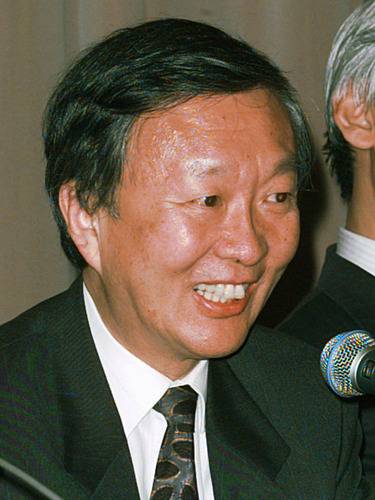
Today, we depend on fiber-optic cables as phone lines and the backbone of the Internet. Fiber optics are so widely used that, according to the Nobel committee, there's enough fiber-optic cable on the planet to wrap around the Earth 25,000 times.
A statement released by the Chinese University of Hong Kong, where Kao served as vice chancellor, detailed his response to receiving the Nobel.
"I am absolutely speechless and never expected such an honor," said Kao. "Fiber optics has changed the world of information so much in these last 40 years. It certainly is due to the fiber optical networks that the news has traveled so fast."
Oooooooooooooooooooooooooooooooooooooooooooooooooooooooooooooooooooooooooooooooooo
http://en.wikipedia.org/wiki/File:Fibreoptic.jpg

http://en.wikipedia.org/wiki/File:Fiber_optic_illuminated.jpg
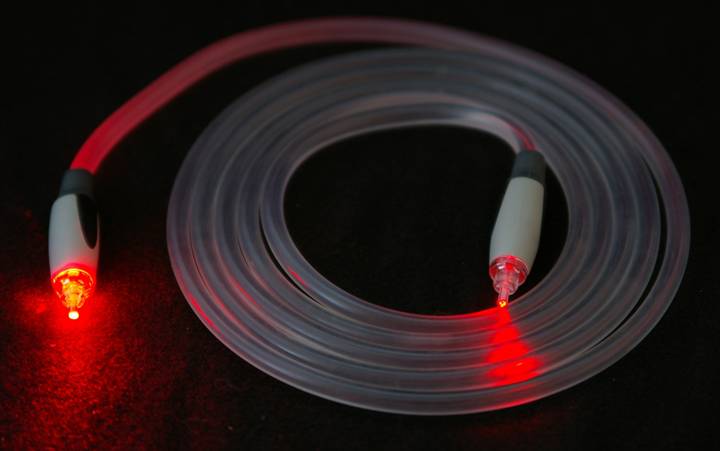
English: A TOSLINK fiber optic cable with a clear jacket that has a laser being shone onto one end of the cable. The laser is being shone into the left connector; the light coming out the right connector is from the same laser.
|
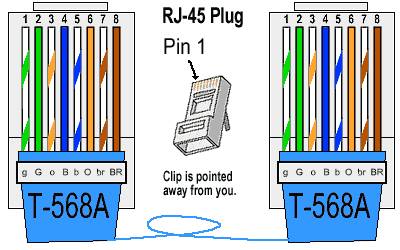
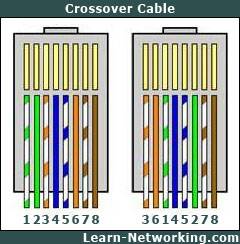
CROSSOVER CABLE |
|
|
|
|

|
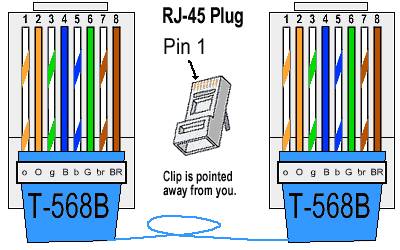
STRAIGHT-THRU CABLE |
|
|
|
|
|
|